Showing posts with label empty lot. Show all posts

Saturday, January 2, 2010

Farming the city.

A mega-rich Detroit libertarian is considering intense urban farming as a solution to his city's woes. I wonder what it could do for other depressed post-industrial cities?


The article (Fortune via cnn) suggests that many view Detroit citizens see the proposal as a selfish land-grab by an untrustworthy 'invader'. I'd have to agree that in this case, it probably is.

Detroit has learned (and I think other cities should take note,) that large corporate entities are not good investments.-- They exploit city space and resources until it becomes no-longer profitable to do so. Then they leave us with the bag in one hand and a dysfunctional landscape in the other.

A few statements in the interview raise red flags for me:

"What if we had seven lakes in the city?" [the millionaire] wonder[s]. "Would people develop around those lakes?"
"It all sounds very exciting," [responds] the DEGC's Jackson, whose agency is working on assembling a package of incentives for Hantz, including free city land. "We hope it works."
Hope it works? I don't know what the outcome will be, but I surely hope that Detroit's citizens get more than such a weak assurance before they consent to let their landscape be used for a for-private-profit experiment.

~

All these Detroit problems aside, I am interested in thinking about ethical large scale public farming could do for other cities.

For a program to be ethical and useful, I think the following guidelines are required:

  • Land to be redeveloped into farm must be land that the neighborhood democratically chooses to be re-purposed.
  • The new farm must be community owned in perpetuity.
  • Farms, if chosen to be run as for-profit by their communities, must return their profits to the farm's home community.
  • Coterminosity is not important--neighborhood integration is important.
Despite it's problems the now-defunct South Central Farm in LA seems to be a good model for how larger urban farms can enrich a city.


(photo:Jonathan McIntosh, South Central Farm, L.A.)

Why raze thousands of acres indiscriminately, as is proposed in Detroit? (at 14 acres, South Central was the largest urban farm in America at the time.)
It seems like the kind of broad stoke that a city or community could regret later, if not well considered.

Hopefully it will be the people, and not just a rich individual or private corporation, that make this call.

~

Also, shout out to archipreneur , an interesting architecture blog, that mentions this story here.

Friday, January 1, 2010

City Limits?

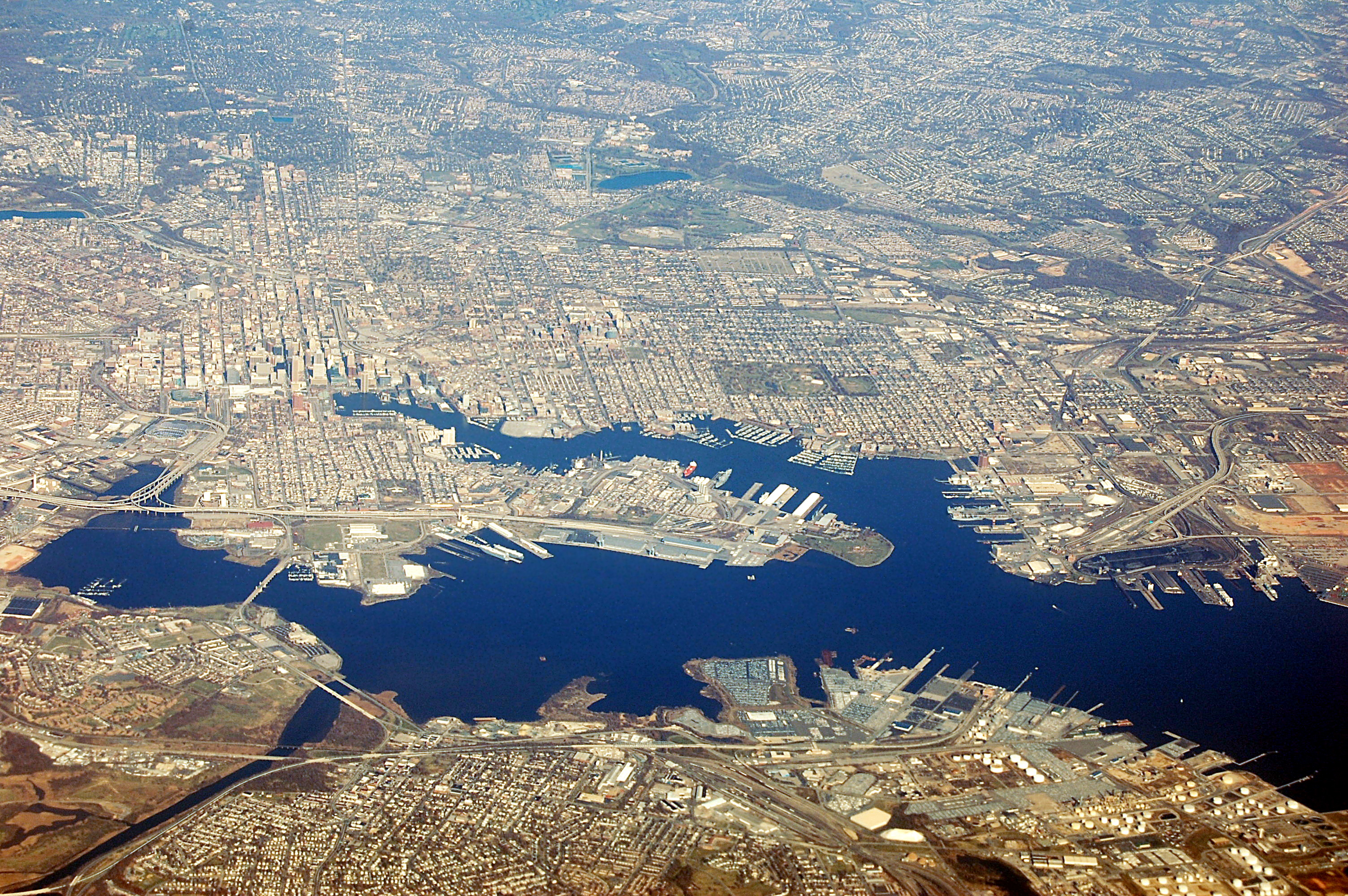
In the 1960's the population inside Baltimore city limits was about 1 million.
Today there are 600,000 in the same space.


Baltimore currently faces the same problems as most older US cities--crime, decay, maintaining infrastructure--
but could it be that trying to solve these problems in our underpopulated city spaces is made more difficult because of all this empty space?

-- much like a single person trying to repair a crumbling house that's far too big?

What about the strategy of shrinking the city to better serve a shrunken population?

These questions spurred me to discover the historical city boundaries of Baltimore.


~


Baltimore became an independent city in 1851, breaking away from Baltimore County.

In The History of Baltimore City and County, from the earliest period to the present day: including biographical sketches of their representative men by John Thomas Scharf, published in 1880,(and found here on google books) I found a map showing Baltimore Town in 1730 and its original 60 or 80?(hard to make out..) acres.


(note that the 'boundaries' are 1880 boundaries--much smaller than in 2010.)

And here's an 1880's map, with historic limits and some unusual tract names. It's funny to recognize some names, like Mt. Royal (a contemporary neighborhood), amid the other wild ones--I wish there were still a 'haphazard' neighborhood!


These early maps all show a relatively small Baltimore in from 1852-1880's.
Baltimore's 1852 population was about 500,000.(census data)

An 1852 map:


Here are Baltimore's Limits today with its 1852 limits (the map above) superimposed:

1852 superimposed

~

In 1888 the city annexed 2 miles to the north limit of the city (Additions included the areas that now include lake montebello and druid hill park) and 2 miles to the west limit, adding 36,000 people and increasing the city space by about 18.5 square miles (my rough calculations) to ~30 square miles.

Before the 1888 annex Baltimore had a population of 380,825 , area of 11.6 sq/mi, and density of ~32,000 persons per square mile.

In 1889 the population was boosted to ~417,000, area 30.1 sq/miles, and density was 13,853 persons per square mile.


(from Baltimore: its history and its people, Volume 1 By Clayton Colman Hall)


The new city 1888 limits looked like this:
1888 annex superimposed


~

Another large annexation occurred in 1919 (Baltimore, Volume 11) that nearly tripled the size of the city:

Baltimore's 1919 annexation:

A link to more details. (Baltimore County police, 1874-1999. via google books.)

~

In 1910 Baltimore had 558,000 residents and was 30 square miles,
population density 18,500 person/square mile.

In 1920, after the annex, it had 733,000 residents in 79 square miles,
and average density fell to 9,200 person/square mile.

And today?...

Its difficult to discern what has happened to the limits since, if anything.

Baltimore now has 80.8 sq/mi of land within city limits--awfully close to the 79 sq/mile total after the 1919 annex.
Perhaps there were was another very small annex, or perhaps land was built into the harbor.

As of 2009, Baltimore has a density of 7,882 persons per square mile--even less than after the 1919 density-dropping annex.

~

Some musings:

From a satellite, there is a visible area of notable development within Baltimore. Maybe this should be the 'city limit'? It pretty much coincides with the city limits in the 1910's:

Baltimore_development

Doubts:

-Maybe we have more parks today, which drives down density but increases happiness.
-Too many parks can be a bad thing.
-What if current density can't be recollected into a smaller, leaner city?
-Can a city contain a more urban core and a 'suburbanish' fringe and not betray or underserve one group?
-Do cities need the tax dollars from suburbs-within-city-limits to pay for the actual city-within-city-limits?

What might resizing to a smaller Baltimore do for its residents, budget, demeanor and quality of life?

Wednesday, December 30, 2009

My Neighborhood's got a hole in it!

The Charles Village neighborhood in Baltimore is a dense, older residential neighborhood circa 1910's, highly walkable with moderate mixed-use zoning.

It's the kind of neighborhood that can make even suburbanites reconsider living in the city. This is a little ironic considering Charles Village itself was established as a streetcar suburb--I believe a car ran up and down St. Paul street before being torn out in the middle of the century.

Today the low 3000's blocks of St. Paul street are the commercial hub of the neighborhood. There's a small grocery, restaurants, coffee shops--and -sigh- new modern condominiums. All in all its an interesting, useful, part of the neighborhood

To some it may even sound like a new-urban paradise--but there is something strange happening here too.
In the heart of this very valuable area is a large field of weeds. Its empty, fenced-off, and it's been this way for years.


Why?

According to a very informative article in the Johns Hopkins Newsletter, a row of turn-of-the-century row homes being used as JHU frat houses and a convenience store were demolished in 2006 to make way for a supposed new block of condos.

'The Olmstead' as it was to be called, has failed to materialize. In the mean time, where there once were people and businesses there is now nothing.


View Larger Map

The developer, Struever Brothers, Eccles & Rouse, had already built another block of ugly, boring, could-have-been-built-anywhere condos across the street. They didn't sell so well, and now it seems that The Olmstead is on hold until the market picks back up.
The bad news is, this is what they said in 2007--that's BEFORE the "credit-crunch" hit the fan!
I guess we could all be waiting a while.

I laughed when I visited the Streuver Bro's website--they claim to be "transforming America's cities." I may just be a cynic, but I think its fair to say that in this case they are transforming my neighborhood into a wasteland.

The sad part , in my opinion, is that the only thing this neighborhood can look forward to someday, is the arrival of another profit-extracting monstrosity when the yuppies finally feel like their portfolios have recovered.

I realize that developers are a fact of life. Private property is good. My only question is this: Should a neighborhood as a community have any say in the evolution of their built environment?

I wish that beautiful old buildings didn't have to be demolished.

I wish they didn't have to be replaced by bland, hulking, over-sized, cynically 'modern' buildings. And furthermore, I wish that 'mixed use' didn't have to mean chain stores. Isn't that what the suburbs are for?

I wish that a lovely neighborhood in a city generally plagued by decay didn't have to be exploited to grow.

I'll be very interested to see what ever becomes of the Olmstead.
~
-finally posting again after a LONG summer vacation!
~
UPDATED: here. Feb 2010.

Tuesday, May 12, 2009

Disappearing city

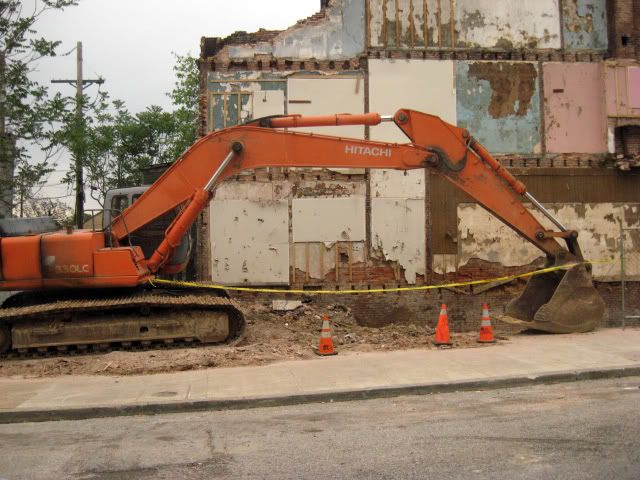
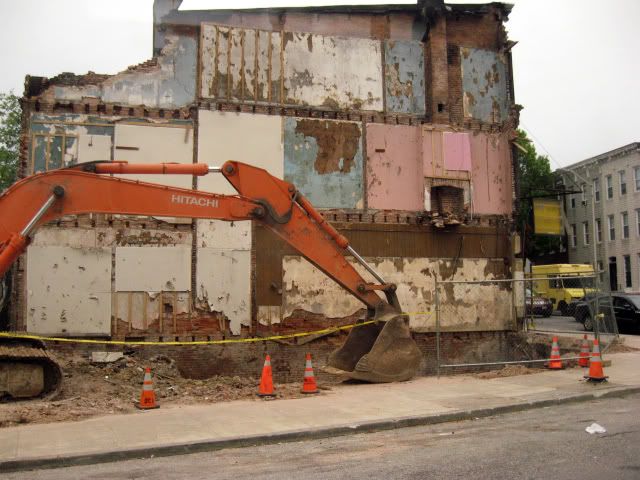
Last week my bus had to take a detour as it traveled south down Greenmount, a major artery passing through a worn-down, low rent, yet busy part of the center city. The reason for this departure from tradition was the apparent collapse of a three story brick row home/ground level commercial space at Greenmount and Preston St. Piles of brick blocked the road and police held back bystanders from the rubble. Unfortunately I didn't have my camera with me on that day; but I did on next:


Its sad, but building decay is becoming a major issue for some U.S. cities on the East Coast and Midwest. Many architecturally significant buildings stand vacant in economically depressed or otherwise undesirable areas and as they approach 100 and 150 years, the elements begin to slowly take their toll.

Alan Weisman's book The World Without Us goes into great detail on how long human structures can last when we aren't taking care of them--and once water is allowed to enter a structure, it usually isn't very long.

Baltimore is fast becoming a perfect example of what a city with too many forgotten buildings comes to look like. The suspicious empty grass lots to be found at the corners of blocks in certain Baltimore neighborhoods are not the planned gardens and green spaces they might appear to be, but actually uncontrolled, "natural", like-it-or-not demolition of the city's built heritage.

A good example of this phenomenon can be seen on Google streetview here.
Is that what the corner of Greenmount and Preston will look like in 5 years?

Here's the corner of the block (courtesy Google) before this week:

View Larger Map

..and as it is now.


It may not have been a building worth preserving, but I doubt it was a building worth demolishing. I think that during a period in which people put so little thought into building sustainably (see: suburbia) the loss of even one medium density building with potential charm and a real history is sad. The funny thing is, these buildings were the suburban tract homes of the 1910's!--except then they were served by streetcars and supported a denser population.

A cool site I discovered recently, Built St Louis, discusses this issue in depth as it occurs in St. Louis, MO. Both Baltimore and St. Louis have been struck by similar historical misfortunes (B.S.L. outlines them very well here.) including white flight to the suburbs and the resulting population loss. In the 1950's Baltimore had a population nearing a million. That number teeters around only 650,000 today. Nobody's left around to take care of all the elderly buildings. sad!

-G