There is a certain building, standing on a (frankly) ugly section of street several blocks south of my home, for which I have a strange affection, despite its being in a nearly complete state of ruin.
I like the home because of its unique brickwork, tall windows and interesting 'pistachio' paint-job. I decided to write about my affection for the home after I recently discovered 2 tidbits relating to its existence.
View Larger Map
First, while googling some addresses as a time-waster, I found a photo of the home in 2006 and was shocked by its much superior condition. Its obvious that a fire occurred on the second floor sometime between September 2006 and 2008. The internet was unable to bring me any details of this unfortunate event.
-->Beautiful photos of the home, pre-crumble, on Flickr here: thepeoplemachine.
(Via Flickr.)
According to city records (If you have time, check out this cool tool.) the home was built in 1890 (along with many homes of the Charles Village district) and is currently owned by the Housing Authority of Baltimore City. I sincerely hope they do not plan to demolish it (they own nearly the whole block it is situated in)--although, I don't know who would possibly be able to front the money to repair it.
Ok, second, also by way of the net, I learned about an artistic revitalization effort focusing on the 2100 block of N. Calvert, called Axis Alley. Its goal, from its website here, is to activate the back alleys of Baltimore and explore the "toxic beauty" and "fascinating possibility of urban intervention and creative gesture" by installation of art/design works in the alleys behind distressed buildings and spaces.
I especially like the phrase "toxic beauty". I feel like this is exactly what drew me to this home and this block in the first place.
Sadly, the deadline for submissions has passed, but it appears applications for proposed projects will perhaps continue to be accepted on an ongoing basis, so who knows, perhaps I will have an opportunity to interact with my favorite building in a more personal way.

Showing posts with label urban decay. Show all posts
Showing posts with label urban decay. Show all posts
Sunday, August 16, 2009


Tuesday, May 12, 2009
Disappearing city
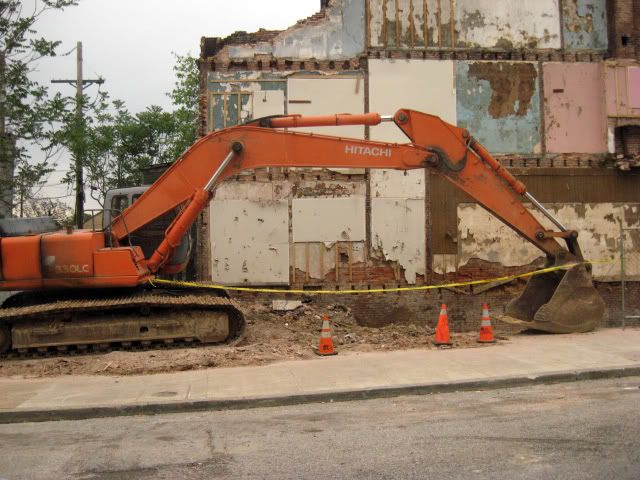
Last week my bus had to take a detour as it traveled south down Greenmount, a major artery passing through a worn-down, low rent, yet busy part of the center city. The reason for this departure from tradition was the apparent collapse of a three story brick row home/ground level commercial space at Greenmount and Preston St. Piles of brick blocked the road and police held back bystanders from the rubble. Unfortunately I didn't have my camera with me on that day; but I did on next:

Its sad, but building decay is becoming a major issue for some U.S. cities on the East Coast and Midwest. Many architecturally significant buildings stand vacant in economically depressed or otherwise undesirable areas and as they approach 100 and 150 years, the elements begin to slowly take their toll.
Alan Weisman's book The World Without Us goes into great detail on how long human structures can last when we aren't taking care of them--and once water is allowed to enter a structure, it usually isn't very long.
Baltimore is fast becoming a perfect example of what a city with too many forgotten buildings comes to look like. The suspicious empty grass lots to be found at the corners of blocks in certain Baltimore neighborhoods are not the planned gardens and green spaces they might appear to be, but actually uncontrolled, "natural", like-it-or-not demolition of the city's built heritage.
A good example of this phenomenon can be seen on Google streetview here.
Is that what the corner of Greenmount and Preston will look like in 5 years?
Here's the corner of the block (courtesy Google) before this week:
View Larger Map
..and as it is now.

It may not have been a building worth preserving, but I doubt it was a building worth demolishing. I think that during a period in which people put so little thought into building sustainably (see: suburbia) the loss of even one medium density building with potential charm and a real history is sad. The funny thing is, these buildings were the suburban tract homes of the 1910's!--except then they were served by streetcars and supported a denser population.
A cool site I discovered recently, Built St Louis, discusses this issue in depth as it occurs in St. Louis, MO. Both Baltimore and St. Louis have been struck by similar historical misfortunes (B.S.L. outlines them very well here.) including white flight to the suburbs and the resulting population loss. In the 1950's Baltimore had a population nearing a million. That number teeters around only 650,000 today. Nobody's left around to take care of all the elderly buildings. sad!
-G
Its sad, but building decay is becoming a major issue for some U.S. cities on the East Coast and Midwest. Many architecturally significant buildings stand vacant in economically depressed or otherwise undesirable areas and as they approach 100 and 150 years, the elements begin to slowly take their toll.
Alan Weisman's book The World Without Us goes into great detail on how long human structures can last when we aren't taking care of them--and once water is allowed to enter a structure, it usually isn't very long.
Baltimore is fast becoming a perfect example of what a city with too many forgotten buildings comes to look like. The suspicious empty grass lots to be found at the corners of blocks in certain Baltimore neighborhoods are not the planned gardens and green spaces they might appear to be, but actually uncontrolled, "natural", like-it-or-not demolition of the city's built heritage.
A good example of this phenomenon can be seen on Google streetview here.
Is that what the corner of Greenmount and Preston will look like in 5 years?
Here's the corner of the block (courtesy Google) before this week:
View Larger Map
..and as it is now.
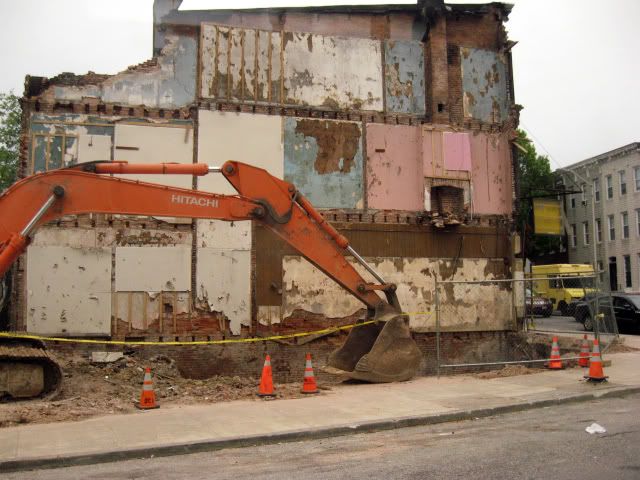
It may not have been a building worth preserving, but I doubt it was a building worth demolishing. I think that during a period in which people put so little thought into building sustainably (see: suburbia) the loss of even one medium density building with potential charm and a real history is sad. The funny thing is, these buildings were the suburban tract homes of the 1910's!--except then they were served by streetcars and supported a denser population.

A cool site I discovered recently, Built St Louis, discusses this issue in depth as it occurs in St. Louis, MO. Both Baltimore and St. Louis have been struck by similar historical misfortunes (B.S.L. outlines them very well here.) including white flight to the suburbs and the resulting population loss. In the 1950's Baltimore had a population nearing a million. That number teeters around only 650,000 today. Nobody's left around to take care of all the elderly buildings. sad!
-G
Subscribe to:
Posts (Atom)